Nvidia's AI Factory in a Box Launches in Just 14 Days
In Berlin, Jensen Huang introduced the DSX POD, a modular project that, according to Nvidia, shortens the deployment of an AI factory from six months to 14 days, provided energy and utilities are ready.
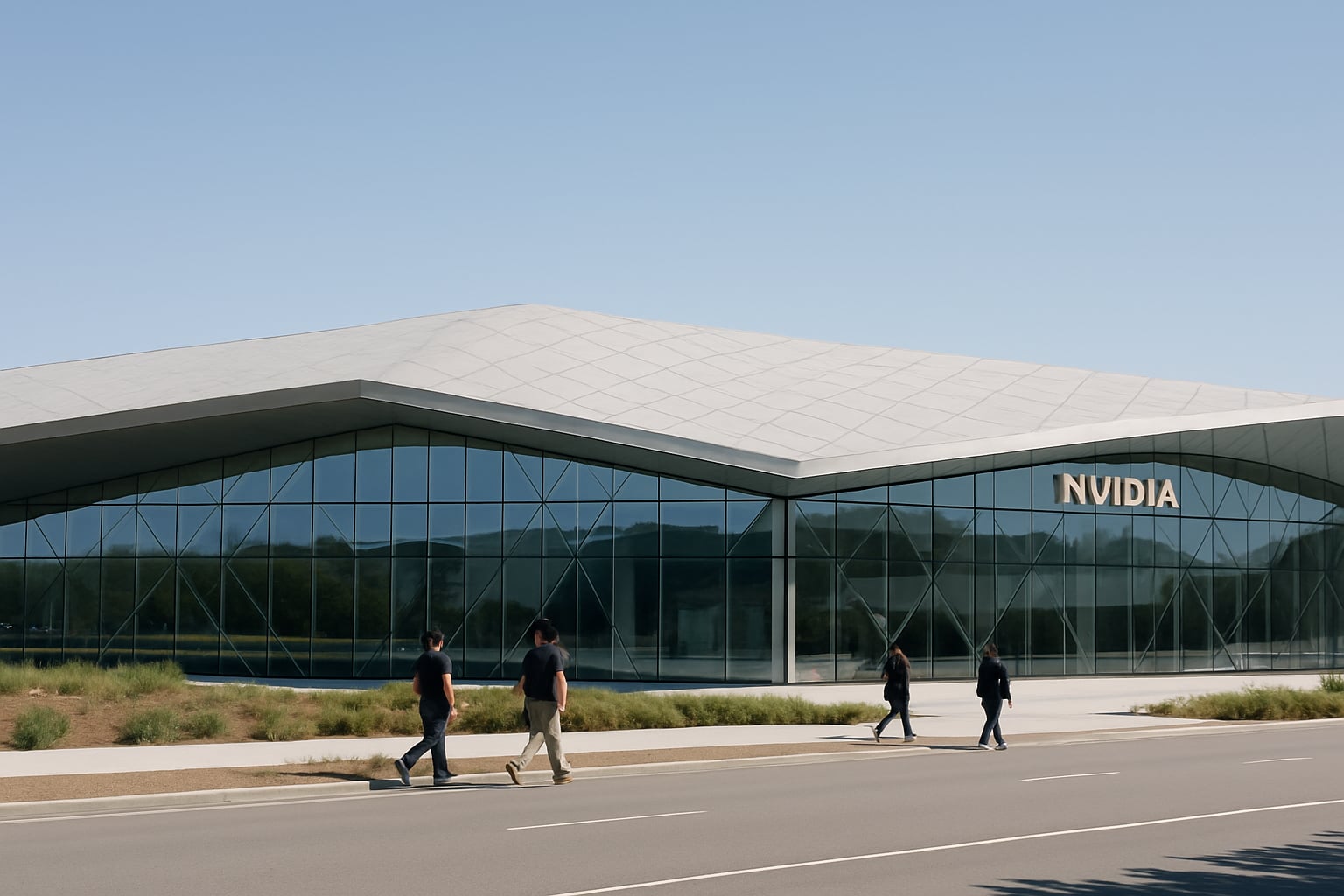
Jensen Huang took the stage at Tempodrom in Berlin on Wednesday (21) to present the DSX POD, a reference project by Nvidia for AI factories set up in modular containers, integrated and validated before arriving on-site. According to the company, once energy and utilities are ready at the location, the deployment timeline drops from about six months to 14 days. Nvidia did not present this number as a measured client result: it is an engineering goal and should be interpreted as such.
The announcement was central to a presentation designed for a European audience. Huang mentioned that Nvidia invested nearly $10 billion in Europe over the last year and that "every company in Europe will become an AI company." The company also launched OpenShell, an open-source runtime that isolates AI agents in a sandbox, and announced that Volvo Cars will adopt the Hyperion platform for automated driving.
The Bottleneck Nvidia Aims to Address
The problem the DSX POD aims to solve is not the chip. It's the construction. In Europe, building an AI data center faces hurdles related to permits, power grid connections, and a shortage of specialized labor, with the time between purchasing GPUs and the first payload typically measured in quarters. A pre-assembled module shifts part of this work to the partner's production line, reducing the time that an expensive asset remains idle waiting for installation.
The caveat lies in the condition Nvidia imposes: "once the utilities are ready." In Frankfurt, Dublin, and Amsterdam—three of Europe's major data center hubs—the bottleneck is precisely energy. Dublin has had restrictions on new data center connections to the grid since 2022. Containerizing the server shortens the part that was already the fastest.
The other aspect is commercial. Nvidia is not only selling the GPU and rack but the complete design of the installation, which increases its share in each project and decreases the space for integrators and construction companies that currently handle this custom work.
Sovereignty as a Selling Point
The discourse in Berlin aligns with a theme that has dominated European industrial policy since 2025: reducing dependence on American clouds for processing sensitive data. Deutsche Telekom has been operating an industrial AI cloud in Munich since February 2026, equipped with up to 10,000 Nvidia GPUs, with SAP providing the software layer. The promise of the DSX POD is to replicate this type of installation in more places, faster, including within telecommunications operators and industrial groups.
There is a contradiction that European governments are well aware of. Data and operational sovereignty improve when the data center is located on European soil under European control. Technological sovereignty, in the sense of not relying on a single foreign supplier, does not improve when the entire reference project comes from the same California-based company. Nvidia sells both under the same label, and the DSX POD delivers the first without resolving the second.
The market has been demanding something else. Analysts preceding the event described Huang's challenge as demonstrating ROI in AI, not new chip specifications. The DSX POD responds to this pressure from the timing perspective: the sooner an AI factory becomes operational, the sooner it starts generating revenue.
Who Feels the Effect
In Germany, the impact is immediate on the automotive and engineering industries, which Huang placed at the center of his presentation by discussing physical AI, robotics, and autonomous vehicles. Volvo's adoption, with headquarters in Sweden and Chinese ownership, of Hyperion shows that the competition for automated driving platforms is already taking place on a continental scale.
In the United States, the modular model appeals to those needing rapid capacity outside large hyperscale campuses, such as banks and state governments. In India, where groups like Reliance and Tata have announced AI data center plans, a pre-assembled module reduces dependence on local specialized labor for liquid cooling. In Brazil, which is discussing incentives for data centers to attract foreign investment, the same argument applies: the cost of energy and connection to the grid remains an issue that no container resolves.
The detail that often goes unnoticed is OpenShell. By launching an open runtime to isolate agents, Nvidia enters the AI security layer, a territory currently contested by identity and endpoint vendors. If the standard catches on, the company already dominating hardware will also begin defining the rules for containing the agents operating on it.
Sources
- blogs.nvidia.comhttps://blogs.nvidia.com/blog/gtc-berlin-2026-keynote/
- investing.comhttps://www.investing.com/news/transcripts/nvidia-at-gtc-berlin-2026-keynote-europes-ai-buildout-93CH-4962500
- qz.comhttps://qz.com/jensen-huang-europe-ai-companies-gtc-berlin-102126
- analyticsindiamag.comhttps://analyticsindiamag.com/deep-tech/from-humanoid-robots-to-telecom-trials-12-major-announcements-at-nvidia-gtc-berlin-2026